
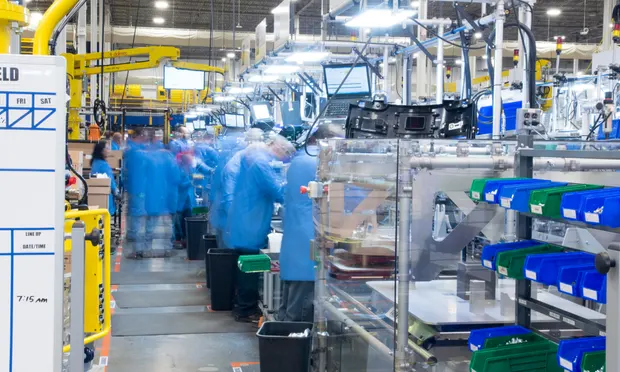
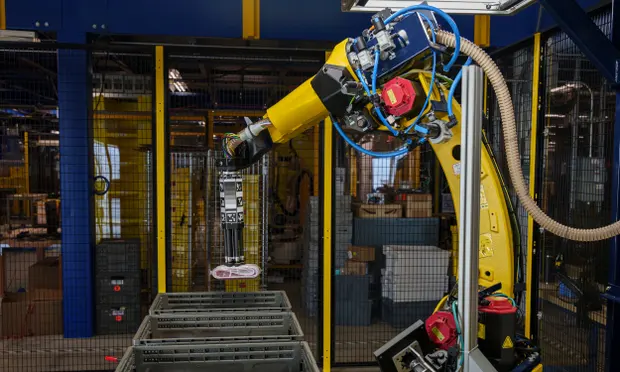
Tucked away in a metal cage in a corner of a 350,000 sq ft Amazon warehouse outside Boston last week, a single yellow robot arm sorted through packages, preparing items to be shipped out to eager customers across the nation. This initial robot will soon be joined by others in a development that could similtaneously signal the end of thousands of jobs and, Amazon argues, the creation of thousands of others.
Amazon anticipate that in the very near future, the robot, called Sparrow, could do the work of the hundreds of thousands of people that Amazon currently employs to sort the 13m packages it delivers each year. Using computer vision and artificial intelligence Amazon says Sparrow can already identify about 65% of its product inventory, tell if an item is damaged and discard it, and adjust its suction cup “hand” to handle different objects – all jobs currently done by human hands. The kicker is that as the robot learns, it gets better by the day.
Sparrow, which Amazon hope to start rolling out next year, was just one of the multitude of new robots on display for the first time at Amazon’s “Delivering the Future” conference last Thursday. Other innovations included an autonomous green robot called Proteuswhich is capable of shifting heavy loads around the largest of warehouses. The company also demonstrated its latest drone which it hopes will allow the company to deliver 500m packages by air by 2030. Meanwhile in another corner of Amazon’s BOS27 warehouse, a fake neighborhood had been constructed, complete with fake grass, fake house fronts with welcome mats, and a giant electric-powered delivery van fitted with tech to inform drivers about the best routes and give “coaching” for better driving. To complete this image of the future, a drone sat on the lawn behind a white picket fence, illustrating how Amazon believes millions of its customers will one day receive their orders.
Tye Brady, chief technologist at Amazon Robotics, believes that the 2020s will prove to be the “age of applied robotics”, saying “Robots will be doing meaningful tasks and extending human capability. I feel like it’s taken 50 years to get here. It’s exciting!”
Over the last number of years, Amazon has become one of the world’s largest private employers, with a payroll of more than 1.6 million by 2021. This period of sustained growth has not been completely painless as Amazon is currently locked in a battle to prevent US warehouse workers angered by low wages and relentless pressure from forming unions and Wall Street has been critical of its perceived over-hiring. The company believes that robot packers, robot movers and robot deliveries could well be an answer to those issues.
Brady however does not agree with this prognostic, noting that people have predicted that robots will destroy the labour market for decades. “I just don’t see that at all,” declared Brady. “We made our first serious investment in robotics over 10 years ago and in those 10 years we created more than a million jobs. More robots will boost the efficiency of warehouses meaning they can store more goods, Amazon will sell more stuff and more people will be needed to make sure everything runs smoothly".
“The need for people to solve problems and use common sense will always be there,” he said. “We are nowhere near that with robotics. It’s not even close. We have millions of years of evolution for the human brain that’s powered off 20 watts and a banana, that’s incredible.”
He might well have a point regarding job numbers as a recent report from the US government’s Bureau of Labor Statistics said there was “little support” for the idea that the new era of smart machines would lead to job destruction. This idea is commonly referred to as the “lump of labor” fallacy by economists. While innovation may destroy occupations, there is however no fixed number of jobs and new jobs are often created to take their place. Warehouse jobs, for example, have replaced retail jobs as online shopping has obliterated shopping malls.It should be noted that all this change isn’t necessarily good for workers. In a paper for the University of Berkley’s Labor Center, Beth Gutelius and Nik Theodore also concluded that tech innovations at warehouses were unlikely to cost significant job losses. They did sound a note of caution, arguing that employers “may use technology in ways that decrease the skill requirements of jobs in order to reduce training times and turnover costs. This could create adverse effects on workers, such as wage stagnation and job insecurity.”
It seems highly unlikely that arguments such as these will slow Amazon’s robot revolution. The company is currently the largest manufacturer of industrial robots in the world, with its Boston facilities already producing 330,000 robots a year. Brady noted that speed was of the essence in delivery and that the customer truly is king, saying “We will react and we will obsess about what the customer wants and if they want their toothpaste faster, we will help them get their toothpaste faster.”
