
New technology delivering safe human-robot collaborations
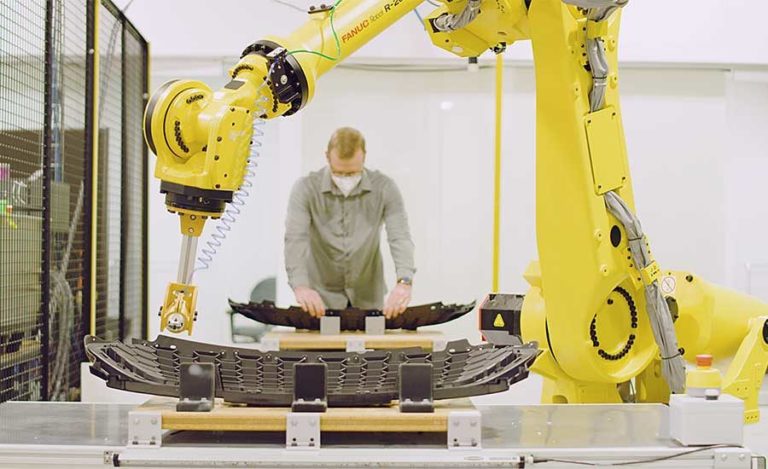
In the past, robots have traditionally worked alone inside safety cages or fences but today, however, more and more applications on assembly lines require humans and machines to…
Flexible Production
Increased demand for flexible manufacturing is behind the trend toward human-robot collaboration. Engineers want to be able to quickly reconfigure their assembly lines for product changeovers, as well as support high-mix, low-volume production. “Ironically, this requirement for flexibility in manufacturing is driving two divergent machine design developments,” claims Todd Mason-Darnell, marketing manager for core technologies at Omron Automation Americas. “First, manufacturers are looking for small modular manufacturing equipment that can be quickly reconfigured, like building blocks, to support evolving production requirements. “Manufacturers are also moving toward large, centrally controlled production lines with multiple operations all being monitored by a single PLC and protected by a single safety controller,” explains Mason-Darnell. “With a centralized control and safety system, [engineers] can easily monitor, control and update [assembly lines] to support changing requirements. “In the traditional model of functional safety, there is a defined, static hazard zone,” says Mason-Darnell. “The role of the safety [device] is to prevent workers from accessing that zone when the hazard is present, or to detect if the worker enters that zone, and then stop the hazardous motion. “Over the last three years, there has been increasing demand for humans and robots to work more collaboratively by actively sharing the same space,” explains Mason-Darnell. “Not only does this increase overall efficiency by allowing both the worker and the robot to complete tasks in parallel in the same area, it also allows more flexibility in production. The robot can perform repeatable, common tasks and the [human] can tackle the variable tasks that may call for creative problem solving. “With the rise of collaborative workspaces, the role of safety sensors has evolved as well,” notes Mason-Darnell. “Rather than define a fixed ‘no go’ area that is the hazard zone, manufacturers are looking for the ability to have an adaptive hazard zone that is updated based on the location and speed of both the robot and the worker. “With this model, the safety sensor is still tasked with locating the worker,” says Mason-Darnell. “However, instead of using that data only to stop or start the robot, it is being combined with speed and payload information from the robot to define in real time the hazard zone, as well as define a safe path and speed of travel for the robot arm. The hazard zone is still a no-go area, but the operation of the robot is being changed to accommodate the safety of the worker while still enabling production.” Increasing use of mobile robots, such as automated guided carts, is also forcing engineers to rethink how they deploy safety sensors on the plant floor. “We see an increased need in safety with automated guided vehicles that move product within facilities,” says Dana Holmes, senior product marketing manager for sensors and safety at Banner Engineering Corp. “Sensors to provide direction and prevent collision are imperative to their success. It is more important now to make sure people are safe working side by side with those robots.”New Products
Manufacturing engineers can choose a variety of innovative safety sensor products that enable humans to work in close proximity to robots on assembly lines. For instance, in response to growing interest in Industry 4.0 technology, Banner Engineering has developed a communication protocol that helps users cut costs, simplify installation and troubleshooting, and prevent and reduce downtime. In-Series Diagnostics (ISD) allows engineers to connect up to 32 devices with one in-series connection and communicate directly with the most commonly used PLCs. “Our SC10 hybrid safety controller has the ability to support two of these ISD chains, giving you 64 devices on your ISD network,” explains Holmes. “When a safety event occurs, the system receives an alert that includes information about which safety device tripped, making troubleshooting a breeze. “In-Series Diagnostics also provides an array of additional data points for each device used, including a unique tag value, internal temperature, voltage, and more, along with device-specific details, such as the alignment and distance between a safety switch’s sensor and actuator,” says Holmes. “Additionally, the system sends warning alarms if devices are near to tripping so that issues can be addressed before your machine shuts down.” Laser scanners are also becoming increasingly popular. The devices continuously scan an area to create a two-dimensional protected zone. They can be used for a variety of horizontal, vertical and mobile applications. “We have standalone units, master and remote units that link up to four scanners, as well as scanners that have encoder inputs that can be read directly by the scanner to select the appropriate safety zone,” says Holmes. “They reduce cost and eliminate the need for functions typically required by additional hardware like a safety PLC. “Laser scanners are ideal for up to 275 degrees of protection from a single unit and can solve complex applications, with up to 70 unique safety zone sets and three independent safety outputs,” Holmes points out. Safety radar systems are also being used in some factories today. Leuze Electronic Inc. recently launched the LBK unit, which utilizes radar waves to determine movement of a worker and stop hazardous movement from a guarded area. “The LBK is immune to environmental concerns, such as liquid, debris, dust, dirt and temperature, which is unique in a primarily optical sensor world of safety sensors,” claims Rod Karch, safety product specialist at Leuze. “The LBK is robust and uses radar waves to detect human movement.” To address increasing demand for robotic safeguarding technology, SICK recently developed the sBot Speed series. It provides the core hardware necessary to implement speed and separation monitoring for collaborative robot applications. “The system can easily be expanded and customized to meet the specific needs of the application,” says Scott. “The sBot Speed systems include software, programming logic and robot manufacturer-specific documentation. This provides customers all the tools necessary to quickly get their safety systems up and running.” Another new product aimed at improving human-robot collaboration is FreeMove from Veo Robotics Inc. The industrial robot safeguarding system, which uses advanced computer vision and 3D sensing technology, recently received safety certification from TÜV Rheinland and has been certified for compliance with ISO 13849 for PLd, Category 3. It works with a variety of robots from ABB, Fanuc, Kuka and Yaskawa. “FreeMove makes it easier for the two most flexible resources in a factory—humans and robots—to work together by providing an easily-installed, complete safety [system] that can be quickly reconfigured as needs change,” says Patrick Sobalvarro, president and CEO of Veo Robotics. “Unlike light curtains and other electro-sensitive protective devices which depend on complex calculations and careful planning by engineers to know which conditions are safe and which are not, FreeMove’s sensors continuously monitor the entire workcell in 3D. “Using this data, FreeMove knows what could be a human and what definitely isn’t; it understands the state of the robot; and it determines automatically and dynamically if that robot needs to slow or stop to keep those humans safe, and when it’s safe to resume operation,” explains Sobalvarro. “FreeMove enables more flexible and efficient workcells by allowing the use of standard industrial robots in collaborative applications,” claims Sobalvarro. “[It] enables manufacturing engineers to safeguard both robot and nonrobot hazards, providing a comprehensive safety system that provides labor savings in the design and commissioning of complex workcells. “This leads to shorter design times, less custom machinery and shorter lead times before workcells are operational,” Sobalvarro points out. “FreeMove also improves robot and human utilization with reduced nuisance faults, providing shorter cycle times, higher unit production rates and quicker fault recovery, all with improved ergonomics and safety.” FreeMove is already in use in pilot installations at a variety of manufacturers in the aerospace, appliance, automotive, construction equipment, consumer goods and electronics industries. Applications include operator load stations, palletizing and parts presentation. “Today, we need more humans in manufacturing than ever, because of increasing demand for customization, flexibility, variation, faster product cycles and quicker response to quality issues,” says Sobalvarro. “The best production environments in the future will be ones where there is [seamless] human-robot interaction.”Related articles
Industry 4.0 and the challenge of cyber resilience
Industry 4.0 - The 2026 edition of the Global Industrie trade fair, held in Paris from 17 to…
Read More
Industrial cybercrime: towards multi-layered protection for Industry 4.0
Industrial cybercrime – Industry 4.0 is now facing a cyber threat of an industrial nature. In March 2026,…
Read More
Industrial robotics – The rise of humanoid robots as industrial partners
Industrial robotics is undergoing a profound transformation. Previously confined to repetitive tasks within safety cages, the new humanoid…
Read More