
HARP Technology - revolutionizing production?
High area rapid printing technology (or HARP) is a new subset of additive manufacturing or 3D printing which can be used to generate continuous, high-throughput printing of large…

What are the uses of HARP technology?
Azul 3D, a startup company led by Mirkin’s group of researchers at Nothwestern, is currently commercializing and developing the HARP technology and was recently named a Formnext Start-up Challenge winner for 2021. Cody Peterson, the CEO of Azul 3d, outlined the company’s ambitions, saying “Our technology helps manufacturers consolidate parts, create new geometries, secure a digital inventory, support localized manufacturing, and design completely customizable products. Our printers will represent a new paradigm in the industry. We will be the go-to solution for manufacturers of industrial, consumer and automotive goods.” Peterson also revealed where he sees the company’s future, declaring “Azul 3D will fill the gap between traditional additive manufacturing (prototyping, molds & tooling, and limited production runs) and traditional mass manufacturing of plastic goods. Our technology and product portfolio fill this unmet need in today’s manufacturing ecosystem.” One of the success stories for the new technology took place at the height of the COVID-19 pandemic when the need for personal protective equipment for frontline medical workers spiked and could not be sourced quickly enough to keep up with the exploding health crisis. To try and solve this problem, the team at Azul 3D used their printers to manufacture masks, face shields and goggles at rates much beyond those possible by traditional 3d printing with Azul able to exceed 1,000 shields per day using a 13-foot tall HARP printer that ran 24/7. Azul were also able to speed up the production of their beta printers and, as a result, shipped over 10,000 shields, many of which were sent to the Navajo Nation as it suffered one of the worst COVID outbreaks in America. The company proudly noted that producing thousands of face shields per week would not have been possible with standard 3D printers, underlining the value in unlocking HARP for mass production of other everyday items. Thegreatest advantage of 3D printing is that it eliminates the need for mold-injected production for tools, which requires workers with specialized skills and offers minimal economies of scale since the tools are often produced in small quantities and are single use only whereas HARP technology can be applied to manufacturing everything from small tools and custom parts to massive wind turbine blades. Azul is a very new player on the 3D printing scene, but the company strongly believes that its powerful technology has the potential to completely revolutionize both small mom and pop shops producing tools and massive corporate manufacturing floors turning out much larger items. It remains to be seen if the company can live up to their slogan, “Your future factory is here!”Related articles
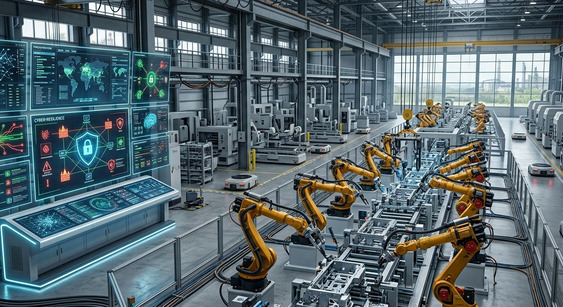
Industry 4.0 and the challenge of cyber resilience
Industry 4.0 - The 2026 edition of the Global Industrie trade fair, held in Paris from 17 to…
Read More
Industrial cybercrime: towards multi-layered protection for Industry 4.0
Industrial cybercrime – Industry 4.0 is now facing a cyber threat of an industrial nature. In March 2026,…
Read More
Industrial robotics – The rise of humanoid robots as industrial partners
Industrial robotics is undergoing a profound transformation. Previously confined to repetitive tasks within safety cages, the new humanoid…
Read More